
Why ube production stays tight
Reports of a shortage point to a production system built on small volumes, not to a crop nobody wants. In mid-August 2026, the Department of Agriculture’s Bureau of Plant Industry suspended exports of fresh ube and propagative planting material indefinitely, citing a domestic shortage of planting stock (da.gov.ph, 14 September 2026). Agriculture Secretary Francisco Tiu Laurel Jr. put it directly: the country does not have enough planting material for itself, let alone to send abroad. DOST-PCAARRD’s research into Bohol’s Ubi Kinampay and other purple yam varieties, published 11 April 2025, names the same limited supply of quality planting materials, alongside low adoption of modern farming techniques, as barriers to steady output. Its own recommendation, besides expanding planting stock, is to strengthen the link between growers and processors.
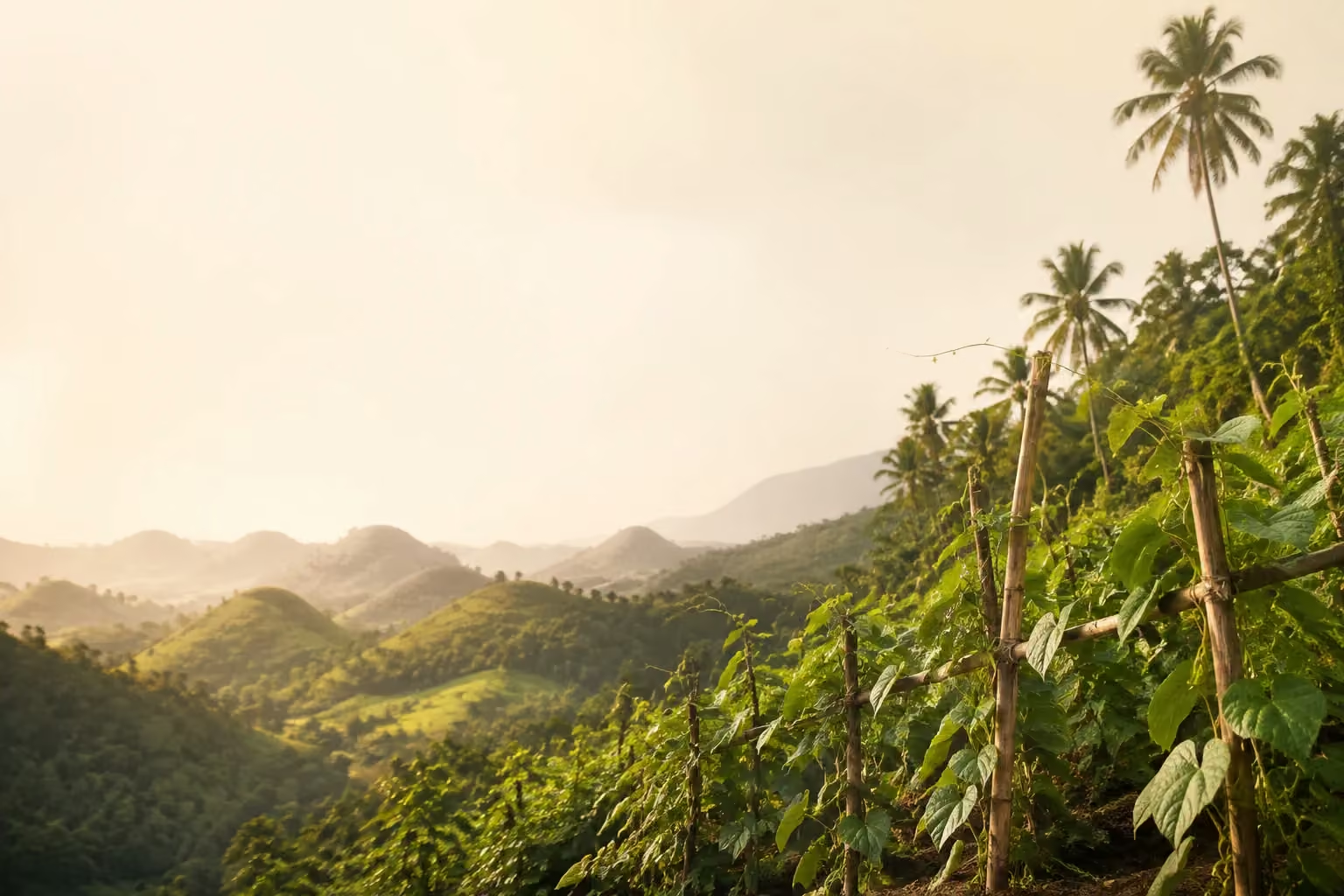
- A production split across small farms. Ube is traditionally grown on small, seasonal plots by smallholder farmers who often lack the funds to expand the land they plant, a fragmentation a BMI research note ties directly to the current bottleneck (cited by Philippine business press, 16 September 2026).
- Processing that stays a bottleneck. DOST-PCAARRD points to weak market linkages between growers and processors as a constraint separate from the harvest itself: getting a tuber out of the ground does not solve the problem of turning it into a finished ingredient at scale.
What the press reports about the 2026 tension
A shortage story travels faster than a production statistic, so it helps to separate what an official body has confirmed from what a press outlet has reported around it. Notice that two of the figures below pull in different directions: production was rising in the first half of 2026 even as the government tightened exports. Tight supply reflects demand outrunning a still-recovering base, not output collapsing.
- 14 September 2026, official. The DA’s Bureau of Plant Industry confirms the indefinite suspension of fresh ube and planting-material exports ordered in mid-August 2026 (da.gov.ph).
- 16 September 2026, official data reported by press. Philippine Statistics Authority figures show national production up 17% year on year in the first half of 2026, to 5,658 metric tons from 4,838 metric tons (Philstar Business, citing PSA).
- 2026, official data reported by press. The same PSA series shows a longer decline, from more than 30,000 metric tons in 2006 to about 12,400 metric tons in 2025 (FreshPlaza, citing PSA).
- 16 September 2026, press analysis. A BMI research note warns the industry’s growth could stall under these supply bottlenecks, an analyst’s reading rather than a government projection (Philstar Business, BusinessMirror).
- 14 September 2026, official. Alongside the suspension, President Ferdinand Marcos Jr. approved a 2027 budget line to expand ube planting material, including tissue-culture propagation and community nurseries (da.gov.ph).
Why ube stays hard to find outside the Philippines
Because the country that grows nearly all of the ube reaching international buyers keeps its fresh tubers and next season’s seed stock at home right now, and because the export base was never built for high volume. The August 2026 suspension covers fresh ube and propagative planting material specifically; the same notice does not name processed forms such as powder or purée, which sit under separate trade rules (da.gov.ph, 14 September 2026). Confirm the current export status of the exact product with a candidate supplier rather than assuming an answer either way: a government notice can change, and this page cannot track that in real time. Even without the suspension, the same fragmented, seasonal production leaves little surplus once domestic demand is served, and a trend that has put ube on menus well beyond the Philippines asks a limited harvest to cover a wider pool of buyers than it was ever sized for.
What a professional buyer does with this tension
A sourcing plan responds to a tight market by moving earlier, not by calling in September for the same shrinking pool of spot lots everyone else wants. Ube still follows a largely seasonal planting cycle in most regions, so timing a request against the ube harvest calendar matters more than it would for a crop available year-round. Build a wider safety margin into the plan than a comfortable market would need: a processor with a full order book this month may not have a free lot next month if planting material stays scarce, and a commitment is easier to negotiate once the immediate rush has passed than in the weeks when every buyer is calling at once. Domestic terms have shifted enough in 2026 that a number published here would be misleading; ask for a comparable quotation instead, and treat any sourcing fee as a line to clarify at that stage rather than a figure to assume in advance.
- Time the request against the season, not the calendar year.
- Build in a wider safety margin than the market seems to need.
- Ask for a comparable quotation, not a headline figure.
A good sample doesn’t prove consistency
A flattering first sample proves that one grower or processor can produce a good lot once, not that the next one will match it. That gap matters more when the overall harvest is tight: a supplier working through fewer, smaller lots has less room to blend away an off batch, and rising demand gives every seller a reason to route the best material to the highest bidder rather than to a repeat buyer. Ask where the tested lot actually came from, whether it represents one farm or several pooled together, and how the next batch will be checked against it before it ships.
- Which growing region and, where the supplier can document it, which variety the sample came from.
- Whether the sample is a single farm’s lot or a blend from several sources.
- What changes between harvests: moisture, sweetness, colour, and how the supplier tracks it.
- Who actually processed the lot, and whether that party can document the process rather than only the origin.
Is ube unique to the Philippines, or grown elsewhere
Ube belongs to Dioscorea alata, a yam species grown well beyond the Philippines, across South East Asia, parts of West Africa, and the Caribbean; the fragrant, purple dessert variety most buyers mean by “ube,” though, stays closely identified with the Philippines. No government dataset found for this page ranks countries by output of that specific dessert-grade variety rather than the wider species, so a precise “biggest producer” claim cannot be confirmed here. What official Philippine sources do track, consistently, is domestic production: PSA figures put 2025 output at roughly 12,400 to 12,500 metric tons, a base the government is now trying to protect and expand rather than a number that says anything about output elsewhere.
Sources & further reading.
- Department of Agriculture - DA indefinitely suspends raw ube exports to secure planting materials (14 September 2026)
- DOST-PCAARRD - Year-round production research in Bohol (11 April 2025)
- DOST-PCAARRD - Dioscorea alata crop profile
- Philstar Business - Ube industry growth stalled by supply gaps, citing Philippine Statistics Authority data (16 September 2026)
Editorial review: 7 September 2026.
Common questions.
Why is ube so hard to find?
Supply is tight rather than absent. Philippine ube comes from small, seasonal farms with limited planting stock, and the government paused fresh ube and planting-material exports in August 2026 to protect that base. Processed forms are not named in that suspension, so availability depends on the specific product and supplier.
What is happening to ube supply in the Philippines?
Production rose 17% year on year in the first half of 2026 even as exports of fresh tubers and planting material were suspended, according to Philippine Statistics Authority figures reported in the local business press. The government is funding planting-material expansion for 2027 while demand keeps growing faster than the harvest.
Which country is the biggest producer of ube?
There is no confirmed government ranking for this specific dessert-grade purple yam, as opposed to the wider Dioscorea alata species grown across several countries. The Philippines is the country most closely identified with ube and the one whose production figures are consistently tracked.
Is ube only available in the Philippines?
No. Dioscorea alata, the species ube belongs to, grows across South East Asia and beyond. What is specific to the Philippines is the fragrant purple variety typically sold as ube, and the current export limits on its fresh form.