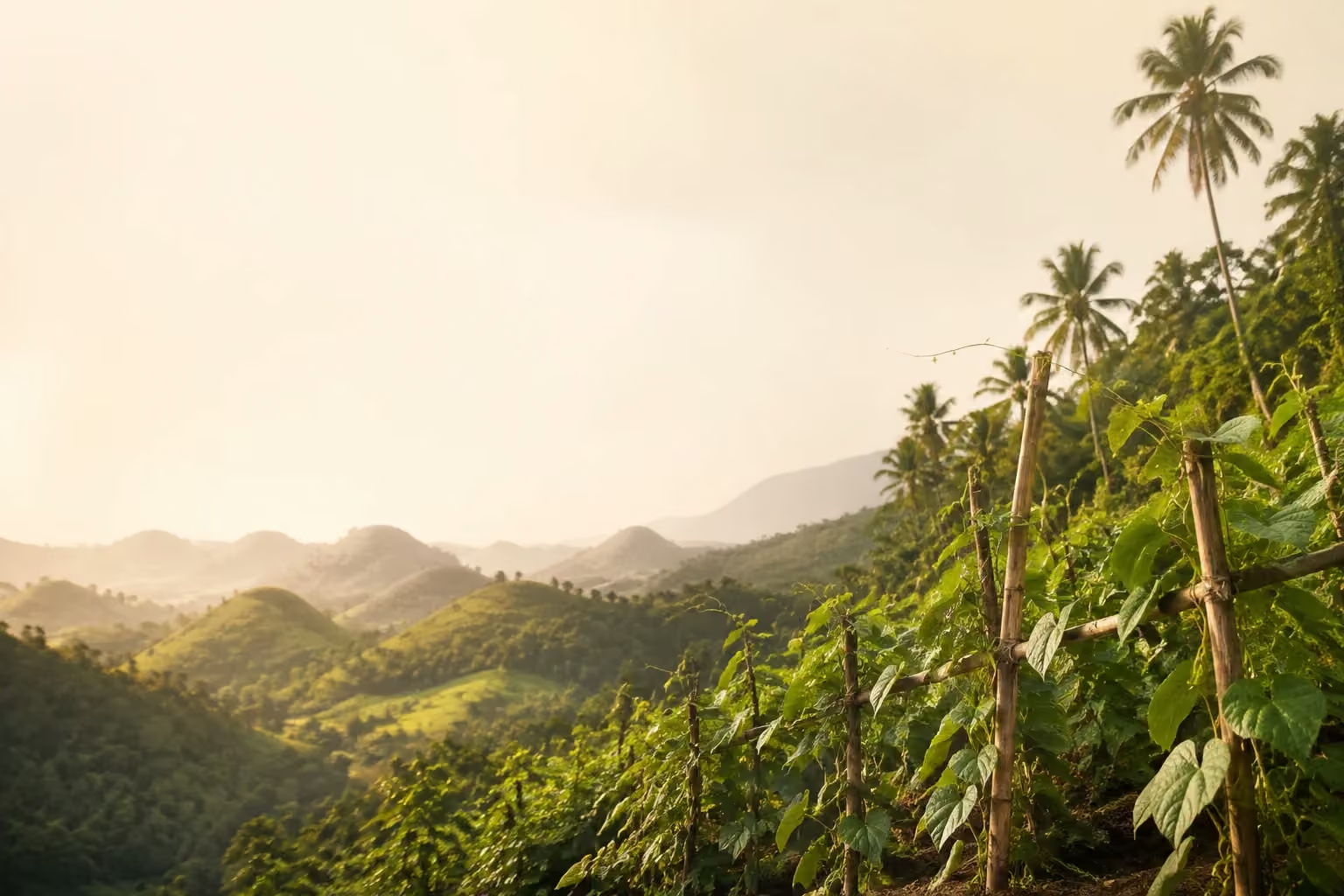
A climbing vine. An underground crop.
Ube is Dioscorea alata, a yam species. The vine grows above ground while the harvested tuber develops below it. This is a different crop from taro or purple sweet potato: similar colour in a finished drink does not establish ingredient identity.
Bohol and the Kinampay story.
Bohol is closely associated with Ubi Kinampay, a variety recognised locally for its aroma and its place in food culture. IPOPHL reported on 16 June 2026 that it had received an application for geographical indication registration for Bohol Ubi Kinampay, filed by the provincial government of Bohol. The announcement gives no filing date, and an application is not the same as a granted registration. The name should not be applied to any Philippine purple yam without evidence.
Growing seasons affect sourcing.
DOST-PCAARRD’s 2025 research note describes work on year-round production of Kinampay and other purple yam varieties in Bohol. Planting material and seasonal availability remain important questions. For buyers, the practical next step is to ask when the raw material was harvested and processed, and how the supplier plans repeat batches.
From a Philippine crop to a wholesale ingredient.
Growing origin and processing location are separate pieces of information. Powder may be milled or blended away from the farm. A complete sourcing brief connects the botanical identity, growing region, composition and processing method with the sample you actually test.
- Ask for the variety and growing region supported by lot records.
- Confirm whether the product is pure yam, a powder with carriers or a sweetened blend.
- Discuss drying, thermal treatment, storage and the intended application.
- Compare the sample with the specification for the proposed commercial batch.
What is documented, region by region.
Public documentation of the sector is very uneven between the island groups. Knowing where the evidence actually sits changes how a sourcing brief should be written, and which door to knock on first.
- In our current base of public sources, the Visayas and Bohol above all are where growing is best documented: growers associations appear through public support programmes and university training sessions rather than through company websites.
- Luzon carries most of the manufacturers and ingredient houses that base documents, with growing appearing in dispersed pockets across the Cordillera, Ilocos and Cagayan Valley.
- Mindanao is thinly documented on the open web. That is a gap in the public record, not a statement about how much ube grows there.
- For a brief: name the growing region you want, and expect it to be evidenced lot by lot rather than assumed from a company address.
Sources & further reading.
- DOST-PCAARRD - Year-round production research in Bohol (11 April 2025)
- IPOPHL - Bohol Ubi Kinampay geographical indication application announced (16 June 2026)
- DOST-PCAARRD - Dioscorea alata crop profile
Editorial review: 7 September 2026.
Common questions.
Is all Philippine ube Kinampay?
No. Kinampay is one named variety. The Philippine ube category includes other varieties, so neither colour nor country of origin proves that a product is Kinampay.
Do these images show your supplier’s farm?
No. The landscape is an editorial illustration. Botanical photographs are separately credited and show the plant in Mindanao; they are not presented as photographs of a contracted supplier.
Can I request Bohol-grown ube?
Yes. Add the growing region or variety to your brief. Availability and documentary evidence must be checked before that origin can form part of a commercial proposal.