
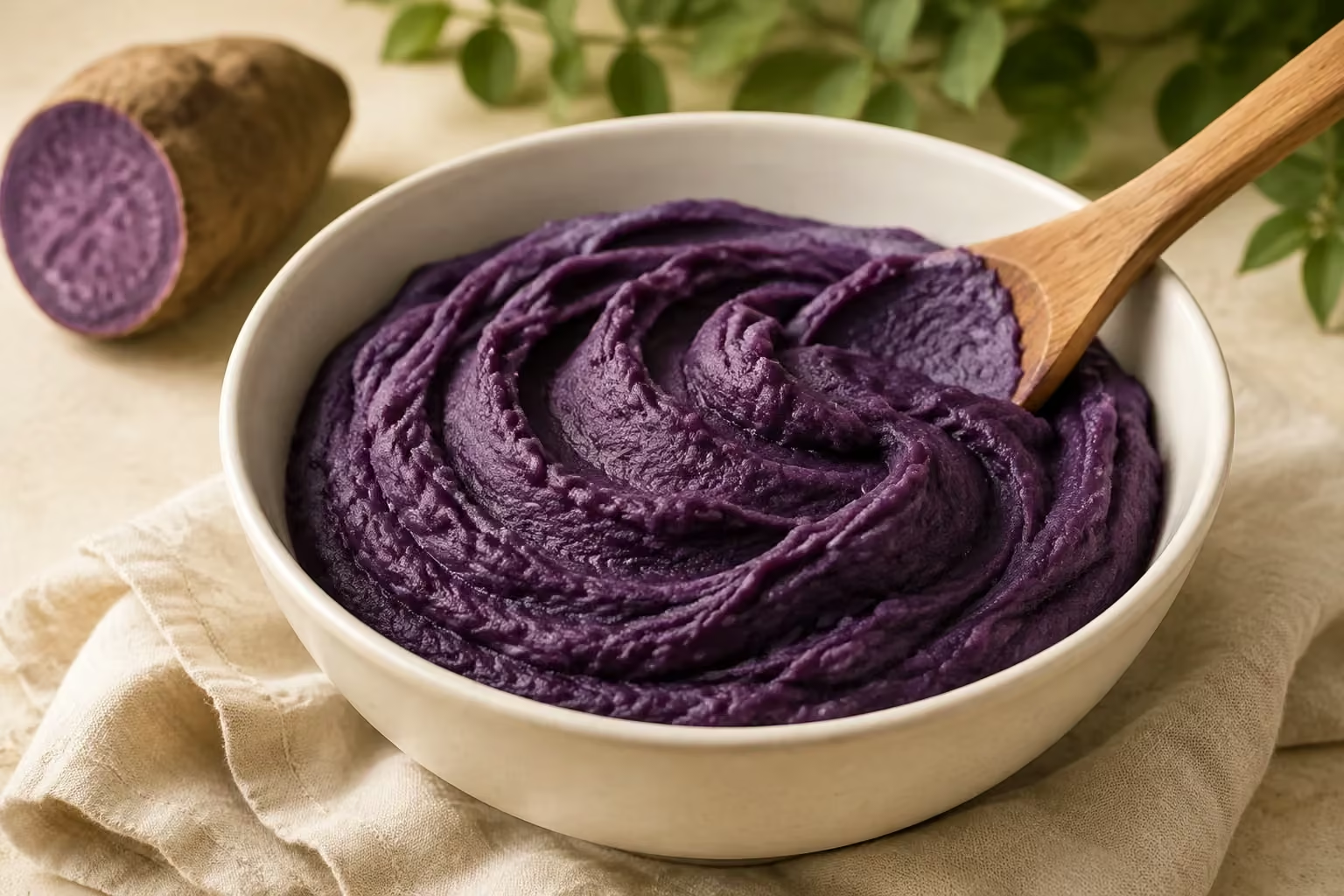
Ube paste, defined for a specification
In a sourcing brief, ube paste usually means cooked, concentrated purple yam with little or no added water. That is a starting definition, not a fixed international standard: ask the candidate processor to confirm the exact composition and process before comparing it with a purée or a rehydrated powder. The distinction matters, because a retail jar sold as an ube spread can rely mainly on sugar and colouring rather than yam.
Paste, purée, reconstituted powder or coloured flavour
These four descriptions get used almost interchangeably online, yet they specify different products. Compare them on state, what has been added and how that changes your process.
- Ube paste: cooked and concentrated, little or no added water, meant to carry a high, verifiable ube content.
- Ube purée: cooked yam kept wetter than a paste, sometimes formulated with added sugar or dairy ingredients depending on the recipe requested.
- Reconstituted ube powder: dried powder mixed with water at the point of use; the final ube content depends on your dose, not on the bag alone.
- Coloured ube flavour: a sweetened, coloured preparation common in retail spreads, where yam can be a minor ingredient rather than the base.
What your specification should state
A paste is compared against a written specification, not a product name. These are the points to put in writing before a sample is judged.
- Exact format requested: paste, not purée or a beverage-ready blend, stated in those words.
- Composition: percentage ube, added sugar, colourings and flavourings, thickeners or dairy ingredients, and whether the paste is sweetened.
- Viscosity and delivery state: chilled, frozen or ambient, and the texture your recipe needs on receipt.
- Packing and cold chain: pack format, storage temperature and the shelf life claimed for that packaging.
- Documentation: ingredient declaration, batch analyses and, for an EU or UK destination, confirmation from the supplier of what their documentation already supports on labelling. Requirements vary by market and should be checked directly rather than assumed.
If a wetter format fits your process
Frozen ube purée follows a different process, with its own composition and cold-chain questions. Compare both formats before you settle your specification.
If a dry format fits your process
Pure ube powder follows different formulation constraints, with its own specification. Compare both formats before you settle your enquiry.
Next: choosing who supplies it
Once the specification is written, supplier qualification decides whether a sample is worth requesting. The same checks apply whatever the format: composition evidence, traceability and a sample compared against more than one production lot.
Common questions.
Is ube paste the same as ube purée?
No. In a sourcing brief, paste generally means a cooked and more concentrated preparation with little added water, while purée is kept wetter. Confirm the exact process and composition with the processor before treating the two as interchangeable.
Can reconstituted powder replace a paste in a recipe?
Not directly. A rehydrated powder's final ube content depends on the water you add, so the same bag can behave very differently at different doses. Test it in your own recipe rather than assuming a direct equivalence with a paste.
Is a coloured ube spread the same product?
Usually not. Many retail spreads sold as ube rely mainly on sugar and colouring, with yam as a smaller ingredient. Ask for the ingredient declaration and the percentage of actual ube before comparing it with a wholesale paste specification.
What if I am importing into the EU or UK?
Labelling requirements vary by destination market and by the exact composition offered. Ask the supplier what their documentation already supports on labelling, and confirm it against your own market's rules before committing to an order.